
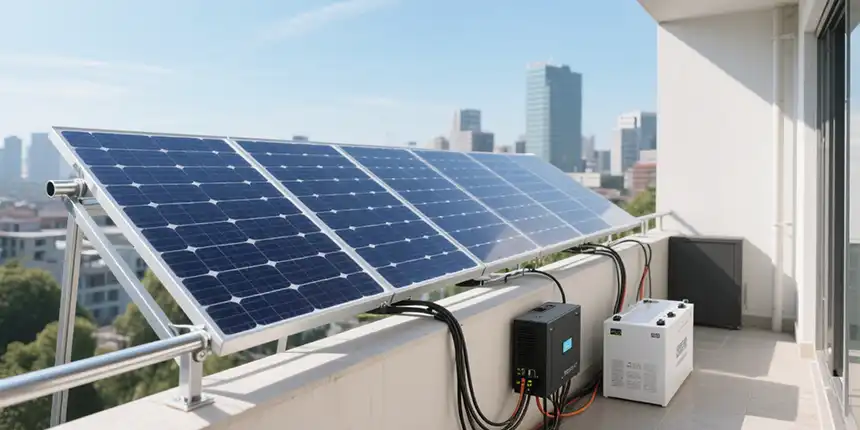
Balcony Solar Systems: Generate Your Own Solar Power
A balcony plant, also called a “balcony solar system“, is a compact photovoltaic installation specifically designed for balconies, terraces, or house walls.
How Balcony Solar System work?
The solar modules on the balcony convert sunlight into direct current (DC). An inverter then transforms this into alternating current (AC), which can be fed directly into the household grid. Home appliances such as refrigerators or computers can run on this power. Any surplus electricity is automatically supplied to the public grid—no battery is needed.
Balcony Solar System Advantages
The main advantage is the ease of installation: most systems are “plug-and-play” and can be connected via a standard socket. In Germany, the current permitted feed-in limit is 600 watts, with discussions about raising it to 800 watts. These systems can cover a large part of a household’s basic consumption. Beyond the financial savings, users also benefit ecologically by reducing reliance on fossil fuels.
Limitations
Not every balcony is suitable for a solar system. South-facing balconies deliver the best performance, while north-facing ones generate far less. In addition, before installation, approval from the landlord or homeowners’ association may be required, especially if the unit is attached to the building façade.
Conclusion
Balcony power plants offer an easy entry into personal energy transition. They are space-saving, cost-effective, and simple to operate, giving many people an attractive opportunity to cut electricity costs and become less dependent on energy prices.