
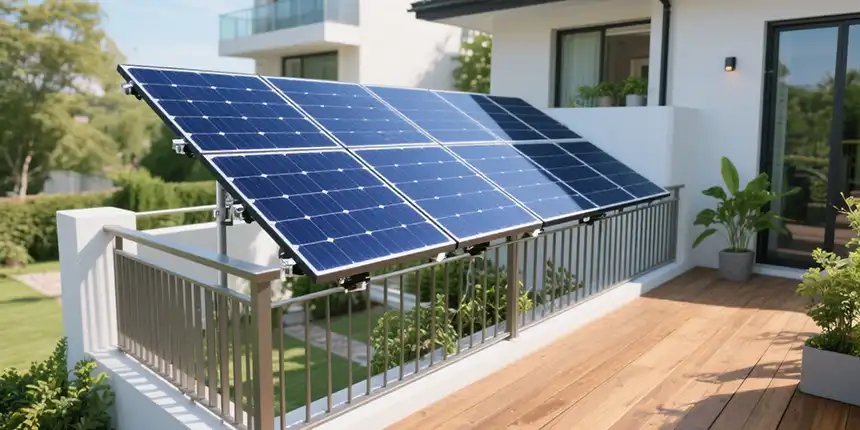
How Does a Balcony Solar System Work?
A balcony solar system is a simple and efficient way to use renewable energy directly at home. More and more people in Germany are choosing this small photovoltaic solution to reduce electricity costs and actively contribute to climate protection. But how exactly does a balcony power plant work?
Structure of a Balcony Solar System
A balcony power plant usually consists of the following components:
-
Solar panels – They convert sunlight into direct current (DC).
-
Micro inverter – It transforms the generated DC into alternating current (AC), which is compatible with the power grid.
-
Connection cable – Through a special energy socket (e.g., Wieland plug) or a standard Schuko socket, the system is connected to the household grid.
-
Mounting system – This allows the solar modules to be securely attached to the balcony, façade, or terrace.
How It Works in Everyday Life
As soon as sunlight hits the photovoltaic modules, they generate electrical energy. The integrated inverter converts this into usable alternating current. This electricity is fed directly into the household grid and is immediately available for self-consumption—for example, for the refrigerator, computer, or washing machine.
If the balcony power plant produces more electricity than is currently being used, the surplus automatically flows into the public power grid. For most models, the output is limited to 600 watts (soon 800 watts in Germany), which only requires a simple registration with the grid operator.
Benefits of a Balcony Solar System
A balcony power plant offers many advantages:
-
Reduce electricity costs: Depending on location and orientation, up to 600 kWh of electricity can be generated annually.
-
Easy installation: With a mounting kit, even non-professionals can install a balcony power plant within just a few hours.
-
Sustainability: Every kilowatt hour of solar power reduces CO₂ emissions and protects the climate.
-
Flexibility: Balcony power plants are suitable not only for homeowners but also for renters, as they can be taken along when moving.
What Should You Consider?
For a balcony solar system to work efficiently, the following factors are important:
-
Orientation: Ideally facing south, alternatively east-west to cover the daily course of the sun.
-
Tilt angle: An angle of about 30–35 degrees maximizes sunlight exposure.
-
Avoid shading: Even small shadows from trees or neighboring buildings can significantly reduce output.
Conclusion
A Balcony Solar System is a cost-effective and sustainable solution to generate your own electricity and reduce dependency on energy providers. With modern technology, easy handling, and quick payback, these mini solar systems are gaining popularity. Investing in a balcony power plant today not only saves money but also makes an important contribution to the energy transition.